
A Structural Break is Underway.
For decades, investment research operated within a stable system.
Research was created, distributed, and consumed in ways that preserved its value. Analysts published reports. Clients read them. Attribution was clear. Entitlements were enforced. And critically, feedback loops existed – producers understood what was being consumed, by whom, and with what impact.
That system is now breaking.
Artificial intelligence is not just enhancing research workflows. It is fundamentally changing how research is consumed.
Research is no longer being read. It is being ingested, distilled, summarized, decomposed, and recombined.
And in that transition, the foundations of the research ecosystem are beginning to erode.
Table of Contents
- The Black Box Problem in AI-Driven Research
- From Research Documents to Structured Data
- Who Owns the Answer?
- A New Research Arms Race in Capital Markets
- The Great Repricing of Research
- The New Consumer of Research
- Why Existing Frameworks Break in an AI-Driven Ecosystem
- AI Governance in Financial Research: What’s Missing?
- The Missing Layer: Infrastructure for AI in Investment Research
- A Moment of Leverage for the Sell Side
- From Platform to Governance Layer
- Defining the Next Generation of Research Consumption
- The Path Forward
- The Window is Now
- BlueMatrix’s AI Mission
The Black Box Problem in AI-Driven Research
As AI becomes embedded in investment workflows, a new consumption layer is emerging – one that is increasingly opaque.
- Instead of navigating to research, users are querying systems.
- Instead of reading reports, they are receiving synthesized outputs.
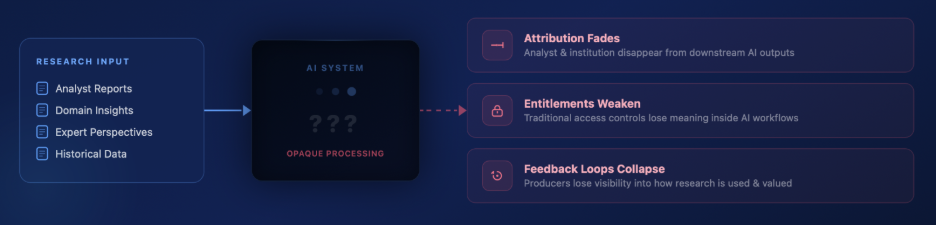
The result is a growing “black box” dynamic:
-
Attribution fades: The analyst and originating institution disappear from downstream outputs.
-
Entitlements weaken: Once content enters AI systems, traditional access controls lose meaning.
-
Feedback loops collapse: Producers lose visibility into how their research is used and valued.
This is not an incremental change. It is more profound than regulatory shifts like MiFID II. Those changes altered the economics of research. AI is altering its structure.
And increasingly, not just content - but the answers derived from it - are separated from their origin.
Read More: The Black Box Problem in Investment Research
From Research Documents to Structured Data
The core issue is this: The industry is still treating research as documents, while AI systems treat it as data.
That mismatch is where value leakage begins.
Large language models do not “read” research the way humans do. They extract signals, recombine insights, and generate new outputs.
In doing so, they sever the traditional links between:
- Content and creator
- Access and control
- Consumption and measurement
Without a new framework, research becomes raw input – detached from its origin and stripped of its context.
Who Owns the Answer?
As research moves from documents to data, a new question emerges - one the industry has not yet fully confronted: Who owns the answer?
In an AI-driven workflow, value is no longer contained within a single report, model, or analyst perspective. It is created at the point of synthesis.
An AI system may draw from:
- Multiple research providers
- Internal notes and models
- Historical content
- Real-time data
…and generate a single, coherent output.
That output is what the end user sees, and ultimately what informs decisions. But its origins are distributed.
The Shift from Content to Outcome
In the traditional model:
- Value lived in the report
- Ownership was clear
- Attribution was direct
In the AI model:
- Value lives in the answer
- Ownership is ambiguous
- Attribution is fragmented
Even if individual sources are known, the final output often abstracts away from them.
The result is a fundamental shift: Research is no longer just produced - it is assembled.
Why This Changes Everything
This introduces a new layer of complexity beyond attribution alone.
Because even if content is properly permissioned and sources are technically tracked, the economic and intellectual value may still concentrate at the point of output.
This creates new questions:
- Who gets credit for the answer?
- Who captures the value?
- Who is accountable for its accuracy?
These are not edge cases. They are becoming central to how research is consumed.
The Risk: Disintermediation at the Answer Layer
If the industry does not define a model for answer-level ownership:
- Research producers risk being reduced to upstream inputs
- AI systems become the primary interface of value
- The connection between insight and origin continues to weaken
This is the logical extension of the black box problem. Not just hidden consumption, but detached outcomes.
Extending the Framework
Solving for attribution at the document level is no longer sufficient. The industry must now consider:
- How attribution persists into synthesized outputs
- How entitlements apply to generated answers
- How usage is measured at the outcome level - not just the input
In other words: Control must extend not just to content - but to the answers derived from it.
A New Boundary for Infrastructure
This is where the role of infrastructure expands again.
- From: Managing content
- To: Governing how content becomes answers
This includes:
- Maintaining traceability across multiple inputs
- Preserving attribution through transformation
- Enforcing entitlements at the point of output
- Providing visibility into how answers are constructed
Read More: Who Owns the Answer?
The New Research Arms Race in Capital Markets
This shift is creating a quiet but powerful competition. Not for distribution, not for readership, but for inclusion inside AI systems.
The firms whose research is most consistently ingested, referenced, and relied upon by AI will shape the decision-making layer of the buy side.
But inclusion alone is not enough... Not without:
- Persistent attribution
- Enforceable entitlements
- Measurable usage
…that value accrues to the system, not the source.
This is the new research arms race: Not just to be used – but to be recognized, controlled, and measured in use.
Read More: The New Research Arms Race: Trust & Attribution
Explore how BlueMatrix supports AI-driven research workflows →
The Great Repricing of Research
As AI reshapes consumption, the market is beginning to reprice what matters.
- Volume is no longer the differentiator.
- Access is no longer the advantage.
Instead, value is concentrating around:
- Data integrity: Clean, structured, high-quality content
- Domain specificity: Deep expertise that general models cannot replicate
- Trust and provenance: Knowing where insights come from, and being able to rely on them
In an AI-driven world, research is no longer just read. It is filtered, ranked, and selected by machines. And those machines are optimizing for signal.

Read More: The Great Repricing: Data Integrity as a Market Filter
The New Consumer of Research
The end consumer is changing as well. It is no longer just the portfolio manager or analyst. It is also:
- Internal AI copilots
- Quantitative models
- Automated workflows
These systems require:
- Structured access
- Machine-readable formats
- Real-time integration
This creates a fundamental shift:
- Centralized thinking
- Personalized delivery
- Machine-mediated consumption
Read More: The New Consumer of Financial Insight
Why Existing Frameworks Break in an AI-Driven Ecosystem
Traditional research infrastructure was not designed for this world.
It assumes:
- Human readership
- Discrete access events
- Static documents
AI-driven consumption is continuous, fragmented, and often indirect.
As a result:
- Compliance frameworks struggle to extend into AI workflows
- Entitlement systems stop at the document level
- Measurement tools fail to capture real usage
Even well-designed governance models begin to break down when applied to AI systems.
AI Governance in Financial Research: What’s Missing?
Many firms are responding by focusing on AI governance. This is necessary, but insufficient.
Why? Because not all AI usage is equal.
Read More: Not All AI Governance Is Equal
The real challenge is not just controlling models. It is controlling how content flows through them.
That requires:
- Granular entitlement enforcement at the system level
- Persistent attribution across transformations
- Visibility into downstream usage
Without this, governance becomes reactive rather than structural.
The Missing Layer: Infrastructure for AI in Investment Research
What the industry lacks is not awareness. It is infrastructure.
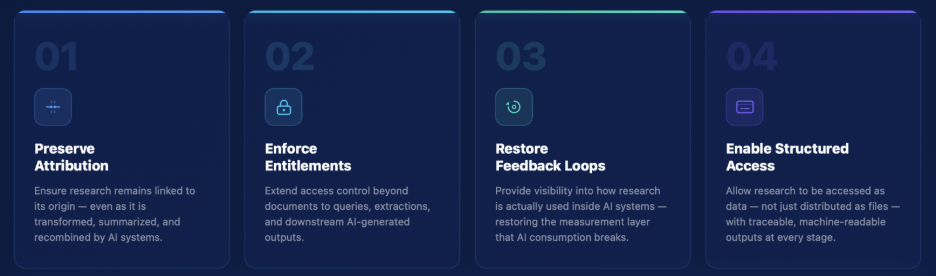
A new consumption model requires a new foundation – one that is designed for machine interaction from the ground up.
This foundation must:
-
Preserve Attribution: Ensure that research remains linked to its origin, even as it is transformed, summarized, and recombined.
-
Enforce Entitlements: Extend access control beyond documents to queries, extractions, and downstream outputs.
-
Restore Feedback Loops: Provide visibility into how research is actually used inside AI systems.
-
Enable Structured Access and Traceable Outputs: Allow research to be accessed as data – not just distributed as files.
See how leading firms are adapting their research infrastructure →
A Moment of Leverage for the Sell Side
This transition creates a rare window of opportunity.
For the first time in decades, research producers have leverage to shape how their content is consumed.
AI systems depend on:
- High-quality
- Domain-specific
- Continuously updated research
That dependency creates negotiating power. The question is whether the industry will use it.
From Platform to Governance Layer
This is where BlueMatrix comes in.
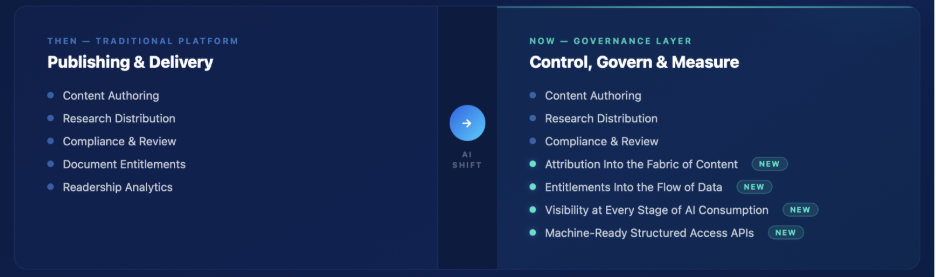
Historically, research platforms have focused on:
- Authoring
- Distribution
- Compliance
But in an AI-driven world, that is no longer enough. The role of infrastructure must expand.
- From: Publishing and delivery
- To: Control, governance, and measurement in machine-driven environments
Read More: AI Model Risk and Its Limits
This means embedding:
- Attribution into the fabric of content
- Entitlements into the flow of data
- Visibility into every stage of consumption
Defining the Next Generation of Research Consumption
The future of research consumption will not be:
- PDFs
- Traditional portals
It will be AI systems interacting directly with research through structured interfaces.
The firms that define this layer will define the industry. Because once the consumption model is set, everything else follows:
- Economics
- Access
- Competitive dynamics
The Path Forward
The industry has two choices.
1. It can allow this new model to emerge implicitly – driven by the behavior of AI systems and the incentives of their builders.
2. Or it can define it deliberately.
To do so requires alignment around a new set of principles:
- Attribution must persist
- Access must remain enforceable
- Usage must be measurable
- Infrastructure must evolve
The Window Is Now
This is not a distant shift. It is already happening.
The question is not whether this transformation will occur.
It is whether the industry will shape it, or react to it.
BlueMatrix’s Mission
To provide the infrastructure that ensures investment research remains attributable from content to answer, stays controlled, and becomes measurable in an AI-driven world.